



Roll over image to zoom in
22.5W bidirectional fast charging module
350.00৳ 400.00৳ (-13%)
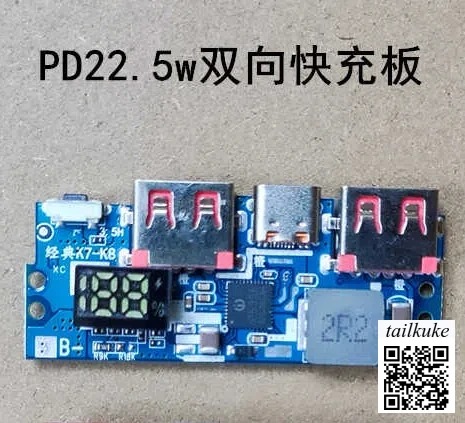
This is a 22.5W Bidirectional Fast Charging Module (IP5356 chip) for DIY power banks.
- Fast Charging: Supports PD3.0, QC4+, SCP, FCP, and VOOC protocols at up to 22.5W output.
- Bidirectional: Fast charges both the connected device and the power bank itself.
- Ports: Dual USB-A (output), one USB-C (bidirectional), and one Micro-USB (input).
- Display: Digital LED screen shows real-time battery percentage.
- Requirement: Connect 3.7V Lithium batteries in parallel (B+ to positive, B- to negative).
Pro Tip: After soldering your batteries, you must plug the module into a charger once to activate the board.
Are you building this into a 3D-printed case or a standard enclosure?
22.5W bidirectional fast charging module
This is an IP5356-based 22.5W Bidirectional Fast Charging Module. It is a high-performance circuit board designed for DIY power banks, capable of both charging itself and external devices at high speeds.

This is an IP5356-based 22.5W Bidirectional Fast Charging Module. It is a high-performance circuit board designed for DIY power banks, capable of both charging itself and external devices at high speeds.
Core Specifications
Main Chip: IP5356 (integrated power management SOC).
Max Power: 22.5W output with efficiency up to 96%.
Fast Charge Protocols:
Input: PD3.0/2.0, QC3.0/2.0, AFC, FCP.
Output: PD3.0/2.0, QC4+/QC4/QC3.0/QC2.0, Huawei SCP/FCP, Samsung AFC, Oppo VOOC, and Apple 2.4A.
Display: Integrated 188-segment LED digital display showing battery percentage and fast-charge status.
Interface Layout
2x USB Type-A (Red): Standard output ports supporting various fast-charging protocols.
1x USB Type-C: Bidirectional port (uses the same port to charge the power bank and to charge your phone).
1x Micro-USB/Lightning (Side): Additional input port for charging the battery pack.
Installation Guide
Battery Compatibility: Use 3.7V Lithium-ion or Li-polymer batteries (e.g., 18650 or 21700 cells).
Connection: Connect batteries in Parallel ONLY (Negative to B-, Positive to B+). Connecting in series (to create 7.4V or higher) will burn the board instantly.
Wiring: Use thick, short copper wires. High resistance from thin wires can cause voltage drops and prevent the module from reaching its full 22.5W speed.
Safety Protections
The board includes built-in safeguards for:
Over-voltage and Under-voltage.
Over-current and Short-circuit protection.
Over-temperature protection (via an onboard NTC thermistor).
Note: After first connecting the battery, you must plug the board into a charger to “activate” it before it will turn on.
Would you like to know the recommended battery capacity for this specific board? 22.5W bidirectional fast charging module
Core Specifications
- Main Chip: IP5356 (integrated power management SOC).
- Max Power: 22.5W output with efficiency up to 96%.
- Fast Charge Protocols:
- Input: PD3.0/2.0, QC3.0/2.0, AFC, FCP.
- Output: PD3.0/2.0, QC4+/QC4/QC3.0/QC2.0, Huawei SCP/FCP, Samsung AFC, Oppo VOOC, and Apple 2.4A.
- Display: Integrated 188-segment LED digital display showing battery percentage and fast-charge status.
Interface Layout
- 2x USB Type-A (Red): Standard output ports supporting various fast-charging protocols.
- 1x USB Type-C: Bidirectional port (uses the same port to charge the power bank and to charge your phone).
- 1x Micro-USB/Lightning (Side): Additional input port for charging the battery pack.
Installation Guide
- Battery Compatibility: Use 3.7V Lithium-ion or Li-polymer batteries (e.g., 18650 or 21700 cells).
- Connection: Connect batteries in Parallel ONLY (Negative to B-, Positive to B+). Connecting in series (to create 7.4V or higher) will burn the board instantly.
- Wiring: Use thick, short copper wires. High resistance from thin wires can cause voltage drops and prevent the module from reaching its full 22.5W speed.
Safety Protections
The board includes built-in safeguards for:
- Over-voltage and Under-voltage.
- Over-current and Short-circuit protection.
- Over-temperature protection (via an onboard NTC thermistor).
Note: After first connecting the battery, you must plug the board into a charger to “activate” it before it will turn on.
Would you like to know the recommended battery capacity for this specific board?


















Reviews
There are no reviews yet.